
FOR IMMEDIATE RELEASE
April 13, 2026
ANCHORAGE, AK — The Alaska Federation of Natives (AFN) released findings in January 2026 from a comprehensive study examining the disproportionate rates of incarceration and recidivism among Alaska Native people and offering culturally grounded recommendations to address these deep systemic inequalities.
Alaska Native people make up about 14–19% of Alaska’s population, yet they account for 44% of those incarcerated in the state’s prisons. Once released, Alaska Native individuals experience a recidivism rate of 60% — the highest among all monitored racial and ethnic groups tracked by the Alaska Department of Corrections (2025). These disparities have serious consequences not only for individuals but also for families, communities, and the overall social and economic fabric of Alaska.
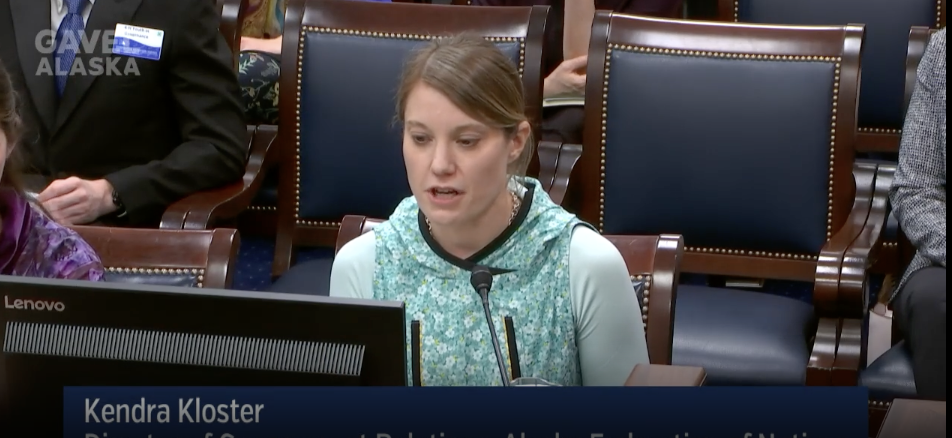
“These numbers are not just statistics — they represent our relatives, our communities, and generations of unresolved trauma,” said Kendra Kloster, AFN’s Director of Government Relations, who played a key role in this study. “This study is a vital step toward understanding the root causes of these disparities and finding meaningful, culturally appropriate solutions.”
Kloster testified before the House State Affairs Committee and Senate State Affairs Committee, and on February 20, she also presented to the Senate Judiciary Committee regarding the Alaska Native Incarceration Report prepared by AFN with the Alaska Department of Corrections, the University of Alaska Anchorage, and the University of Alaska Fairbanks. The DOC contracted AFN to conduct a study to offer recommendations to reduce the overrepresentation of Alaska Native people in the criminal justice system, a provision added in House Bill 66, an omnibus crime bill that passed in 2024.
The study was ordered under Section 64 of House Bill 66, passed by the Alaska Legislature in May 2024 and signed into law on October 9, 2024. The legislation instructed the Department of Corrections to contract with a statewide Alaska Native organization to examine why Alaska Native people make up such a disproportionate share of the state’s prison population and to create practical recommendations.
AFN partnered with the University of Alaska Fairbanks (UAF) Center for Alaska Native Health Research (CANHR) to conduct community interviews, surveys, and a comprehensive literature review, and with the University of Alaska Anchorage (UAA) Alaska Justice Information Center (AJiC) to analyze data on Alaska Native overrepresentation in jails and prisons. The effort was guided by an Indigenous-led Advisory Team of Alaska Native individuals who bring lived experience and professional expertise from tribal programs, tribal justice systems, and community advocacy.
The study examines eight key areas for intervention identified in the legislation, including:
- Establishing restorative justice programs tailored to Alaska Native cultural needs
- Early intervention for at-risk Alaska Native youth and young adults
- Expanded mental health diagnosis and treatment
- Affordable housing solutions to reduce homelessness and law enforcement encounters
- Improved alcohol and drug misuse treatment options
- Job training and mentoring opportunities
- Digital access and training for tribal, state, and federal services
- Identification of federal funding opportunities across agencies, including the U.S. Department of Justice, Indian Health Service, SAMHSA, and the U.S. Department of Labor
AFN recognizes that meaningful reform requires collaboration across policymakers, justice stakeholders, and Alaska Native communities. Reducing these disparities is both a matter of justice and fiscal responsibility — and a pathway to healthier, safer, and more resilient communities throughout Alaska.
The full study is available here.
###